
Pushing the Shame Button
Tuesday Tools ... for YOU TODAY

What is shame? And why do we have it?
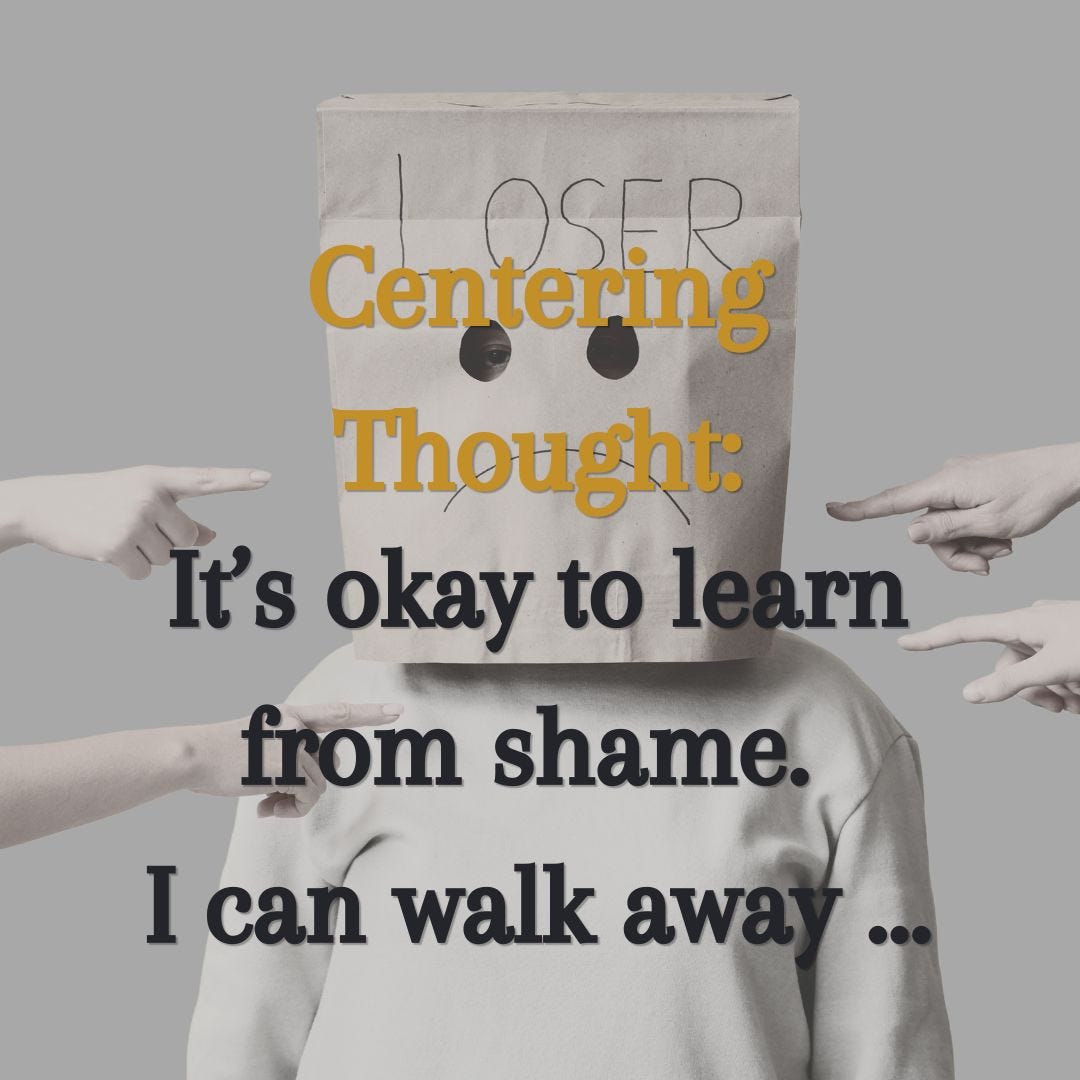
Shame, one of the negative emotions, is often difficult to experience. While we can label mad, glad, sad & scared as “The 4 Corners of Feelings” that other emotions derive from, shame has a complexity in its place on the continuum of sadness.
Shame has related feelings, like embarrassment & guilt. These cousin-feelings may hit differently in our bodies. They may feel similar, but subtly distinct.
For many people, embarrassment can have a whole-body sensation. It can commonly be accompanied by a desire to walk away, to leave the situation where one was embarrassed, particularly for men. Embarrassment can be written all over our faces, too——blushing, or flushing, as the blood rushes to our cheeks, neck, chest up from the heart.
Guilt is less external, but can be difficult to shake. It can feel like a weight on the shoulders.
And then there is shame. It shows externally (heads bowed automatically, the blushing associated with embarrassment, exiting the room in a need to get away, as well).
Inside, it can feel like a gut-punch.
Experts connect embarrassment, guilt and shame to disgust and/or sadness. They are each varying degrees of internal or external responses to social gaffes——big or small. Our human response to each is often aversion.
Why do we have such strong emotions that we so deeply want to avoid? In simplest terms: To shame someone is to trigger a set cost for breaching social contracts.
If a small child runs into the street, we may yell at them, intentionally scaring them, so that they do not make this mistake repeatedly. We help them connect fear to the outcome they cannot see, because as adults, we do see it; and we know they cannot come back from such a dangerous mistake——at least not whole and healthy. However, if a small child harms an even younger child or an infant, we ratchet up the social cost, attaching shame to our responses to teach the lesson indelibly, rather than risking a repeat. Even the gentlest parenting scripts can include these approaches, noting them as exceptions to softer rules.
Shame becomes a social leverage when it is connected to non-life-threatening events. Missing the mark on a work deadline or volunteer task is not deadly, but it does have a big cost if it loses money for the company or disrupts the mission of the organization. These equate to a sort of ‘death’ for the group.
But what is the cost of pushing each other’s shame buttons for small infractions? Forgetting to pick up your partner’s favorite shampoo turns into the shame of “never paying attention,” echoing the teacher-criticisms from school days. Losing your keys turns into the shame of irresponsibility that traps you in a permanent adolescence, even in adulthood. Being too tired for intimacy breeds the shame of emasculation.
We can get our buttons pushed by old tracks that play in our heads. And we can use others’ shame buttons as handles for manipulation, as well. Once we learn what triggers another’s shame, it can be quite tempting to simply hit that button to get our way.
Over-used shame buttons create an emotionally unintelligent society where members of the group operate in at least a low-level state of fight-or-flight that dulls decision-making and numbs the ability to understand the very important data our feelings can give us about our environment. There is a cost to pushing each other’s buttons more than rarely.
Once we do recognize what “pushes our buttons,” or drives us into feeling ashamed——if it’s beyond strictly having made a dangerous mistake——we can notice when others around us are trying to trigger unearned shame in us. This personal emotional awareness can then help to end the cycle of over-shaming.
Centering Thought: If I am ashamed of myself for making a dangerous mistake, it’s okay to feel that shame & learn from it. If I am over-using the Shame Button——letting someone shame me for simple mistakes or relying on shame to manipulate someone else to get my way——I’m not practicing self-awareness or emotional intelligence. I can walk away from this outdated practice.
• Like this post? Order your very own copy of My Moody Daybook to get tools you can use for all your human feelings right at your fingertips.
• Need more confidence or emotional intelligence? Discover the link between confidence & EQ at Coach Kiki’s Skool community, Confident Communicators Club
I'd never thought of shame as a weapon. Such an insidious thing